

by Richard Whiddington on ARTNET – November 19, 2025
Christie’s has halted the sale of a rare 17th-century arithmetic machine that was due to be auctioned on November 19. Hours before the Pascaline, named after its polymath inventor Blaise Pascal, was set to hit the block, The Administrative Tribunal of Paris suspended the export license it had granted back in May after concerns were raised that the machine should not leave France given its historic nature.
A spokesperson for Christie’s highlighted the provisional nature of the decision and said it had followed the instructions of the Pascaline’s consignor, Léon Parcé, to suspend the sale until a final ruling was made. Just how long this process might take remains unclear.
The Pascaline, which was given an estimate of €2 million and €3 million ($2.4 million–$3.5 million), had drawn significant interest from serious bidders, the spokesperson for the auction house said. “We are confident that once the export issues are resolved, a public sale would be successful should it be pursued.”
The decision follows pressure from French cultural campaigners, who believe the Pascaline should be classified as a National Treasure, an official designation that safeguards cultural objects by barring them from export. In an op-ed published in Le Monde on November 1, leading academics and scientists called the Pascaline a shining symbol of French science and technology that demonstrated the country’s pivotal role in developing the modern computer.
“We urge the State to reconsider the export authorization that has been issued,” the authors wrote. “The Museums of France, their patrons, and the individuals who regularly contribute to the safeguarding of our heritage, should come to an agreement for Pascal’s Pascaline to remain at the heart of our collections.”
In a statement, the Administrative Tribunal of Paris indicated the Pascaline would likely be classified as a National Treasure given its “historical and scientific value.”
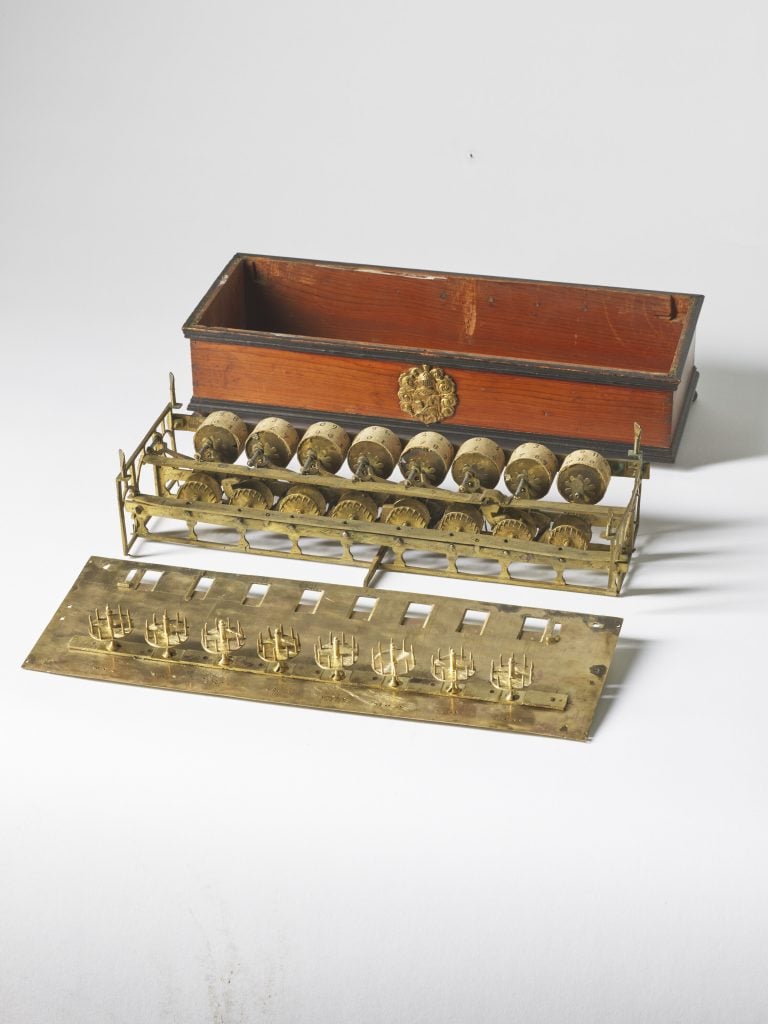
Pascal stopped making his machines in 1654 due to the high cost involved. Photo: courtesy Christie’s Paris.
Behind Pascal’s Mechanical Marvel
In the early 1640s, Pascal had entered the family line of work, helping his father, a tax collector in Rouen, a city northwest of Paris. Pascal was no ordinary teenager. A child prodigy who’d already written papers on geometry and the physics of sound, he sought to ease the burden of the endless calculations that the job required.
He got to work designing a calculating machine that used input dials operated by a stylus and shrinking technology previously deployed in turret clocks and water wheels. By 1642, Pascal had a working prototype, the world’s first mechanical calculator capable of adding and subtracting. Seven years and more than 50 iterations later, he’d received a royal privilege from King Louis XIV, granting him the exclusive rights to design and manufacture calculating machines in France. Accordingly, the machines became known as Pascalines.
Pascal developed three types of machines. One was for accounting, with dials representing the Sols and Deniers of the Livre, France’s currency at the time; another was for decimal calculations, capable of performing addition, subtraction, multiplication, and division; the last was for surveying land. The machine that was due to be sold at Christie’s is an example of this last type and is the only known survey model remaining.
It was calibrated to handle pre-metric French units of length in which 12 lignes (roughly one inch) were equal to a pounce, 12 pounces were equal to a pied, and six pieds were equal to a toise (roughly six feet and four inches). The Pascaline functions through a system of toothed wheels and an ingenious carry mechanism. On the outside, each dial represents a digit and users turn dials to input numbers, rather like operating an old-fashioned telephone. Inside, once a wheel completes a full revolution, a weighted lever known as a sautoir falls and engages a bar connected to the next wheel, thereby carrying the number.

Augustin Quesnel, Blaise Pascal (ca. 1691). Photo: courtesy National du Chateau, Versailles/Getty Images.
The Pascaline was the star lot from the library of Parcé, a keen collector of the inventions and writings of the 17th-century polymath. The other Pascaline machines are held all at European museums, including four by the Musée des Arts et Métiers in Paris, two by the Henri-Lecoq Museum, and one by the State Art Collections in Dresen. Parcé’s model was acquired by an antique dealer in 1942 from a seller who mistook the machine for a music box. It sits in a wooden case, bordered with ebony on its top and bottom, with the Pascal coat of arms affixed in brass on the front. More than three and a half centuries on, it remains fully functional.
“The Pascaline is a scientific instrument of considerable historical value. Undoubtedly the most important scientific instrument ever offered at auction,” Christie’s said in a statement ahead of the auction. “It is the first attempt in history to substitute the human mind with a machine. Its invention marks a breakthrough, a ‘quantum leap.’”
This story was originally published on September 11, 2025. It was updated on November 19, 2025, at 11.27 a.m. ET, to reflect the halted sale.